Hey everyone! Let’s cut to the chase—if you’ve been researching countertop or surface materials lately, chances are you’ve stumbled on artificial quartz stone. You’ve probably also seen conflicting stuff online: some say it’s basically scratch-proof, others claim a random fork left a permanent gouge. As a quartz stone supplier who’s been deep in this material for years, I’m here to set the record straight, no fluff, just real, honest answers. No jargon, no overhyped marketing—just what actually holds up. Artificial Quartz Stone
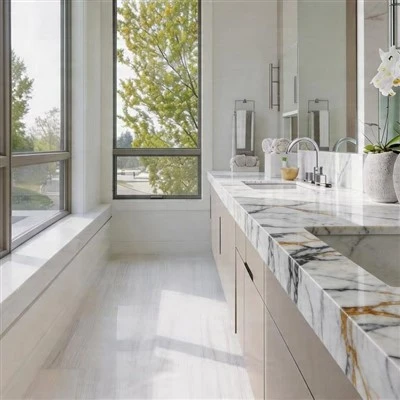
First, let’s get one thing out of the way: artificial quartz stone (often just called quartz for short) isn’t 100% pure quartz. If it were, it’d be way too brittle for daily use and way more expensive than anyone would pay. What you’re buying from places like us is a mix—usually 90-95% crushed natural quartz crystals, bound together with a small amount of polymer resin (like polyester or acrylic) and sometimes tiny additives for color or UV resistance. That mix is key to how it performs, especially when it comes to scratches.
Let’s talk scratch resistance basics. Scratches happen when a harder material drags across a softer one, right? It’s all about Mohs Hardness Scale—every material gets a number from 1 (softest, like talcum powder) to 10 (hardest, diamond). Natural quartz clocks in at 7 on Mohs, which is pretty tough—most everyday stuff falls below that: a penny is ~3, a nail is ~2.5, a kitchen knife blade is around 5.5. So wait, if natural quartz is 7, and our resin is only 5 or 6, does that bring the whole mix down? Yep, it does, but not by much. Most quality engineered quartz hits a Mohs score of 6 to 6.5, which is way higher than, say, granite (which is 5-6) or laminate countertops (which is just 2-4). That’s why quartz is such a popular pick for kitchens.
But here’s where people get confused: not all quartz is the same. We see this all the time as a supplier. We’ve got our premium lines that go through extra curing processes—high-pressure compaction, controlled heating to make the resin set super tight—and then there’s the cheap stuff you might find at a big-box store for half the price. The cheap stuff cuts corners: less quartz, more resin, lower quality binding agents. That’s the stuff that scratches like crazy. I remember a customer who bought cheap quartz for his rental property, and after a month, his tenants had scratches from can openers and moving pots. He reached out to us to replace it, saying he thought quartz was supposed to be tough—turns out he grabbed the wrong grade.
So what actually scratches quartz? Let’s list the culprits, straight from our day-to-day experience. First, anything with a Mohs score higher than 6.5. That’s things like ceramic dinnerware (some are 7-7.5), porcelain tile (also 7+), and of course, diamond tools—if you drag a diamond-tipped drill bit or glass cutter across your quartz, that’s a guaranteed scratch. Wait, what about metal? Your kitchen knife—most stainless steel knives are around 5.5, so they shouldn’t scratch quartz, right? Well, that’s true if the knife is brand new and sharp, but if it’s a dull knife, or if you’re sawing back and forth really hard (like hacking at a frozen pizza pan on your counter), that metal can act like a rough abrasive and leave a mark. Also, if you drop something super heavy with a sharp edge, like a cast iron skillet, that can chip or scratch too—though that’s less about hardness and more about impact.
What doesn’t scratch quartz? Most everyday kitchen stuff, honestly. Spoons, forks, regular pots and pans, cutting boards (as long as you don’t skip using them—we’ve all been there, cutting bread on the counter), even bottle openers. I’ve got a sample board at our showroom that’s been tested for over a year—we’ve dragged ceramic plates across it, dropped canisters, even used a knife a few times, and there’s barely a mark. Compare that to the laminate counter in my old apartment, which had a permanent scratch from a coffee mug just being set down wrong.
Wait, but what about polishing scratches? A lot of customers ask us about this. Sometimes when you get a custom cut, or during installation, the fabricator might leave tiny polishing marks. Those aren’t scratches from use—they’re from the finishing process, and they’re super easy to buff out if you notice them early. We always tell our installers to do a final walkthrough with the customer to point that out, so there’s no confusion later.
Another myth: cleaning products. Can harsh chemicals scratch quartz? Nope, that’s not how it works. Scratches are physical abrasions, not chemical. Quartz is non-porous (unlike granite, which needs sealing), so chemicals can’t etch it either, but that’s a whole other topic. The only thing chemicals might do is dull the color if you leave something like nail polish remover or bleach on it for days, but that’s not a scratch.
So what’s the real takeaway on scratch resistance? Quality is everything. If you buy a reputable engineered quartz from a supplier that does proper manufacturing processes (like we do—we use 93% natural quartz, high-pressure vacuum forming to eliminate air bubbles, and a UV-cured resin that’s extra tough), then it’s way more scratch-resistant than most other countertop materials. But if you go for the bargain bin quartz that’s just a thin layer of quartz over cheap resin, you’re going to get scratches. Also, common sense goes a long way—don’t drag diamond tools across it, use cutting boards, and you won’t have to worry about everyday marks.
Let me give you a real example from a recent project. We supplied quartz for a family’s new kitchen—they have three kids, a dog, and host dinner parties every weekend. Six months later, they reached out saying they thought there was a scratch near the sink. We went out to look, and it was actually a mark from a metal whisk they’d left leaning against the counter that had some metal shavings stuck to it. We buffed it out in five minutes, no problem. If they’d had laminate, that would’ve been a permanent scratch, I’m sure.
Another thing people don’t talk about: repairability. If you do get a scratch on good quartz, it’s almost always fixable. A qualified fabricator can sand the scratch down with fine-grit sandpaper, polish it, and make it almost invisible. Laminate? Once it’s scratched, that’s it—you have to replace the whole surface. Granite? You can fix scratches, but it’s way harder because you have to re-seal it too. Quartz? We’ve fixed hundreds of scratches for our customers over the years, no issues.
Wait, let’s address the elephant in the room: what about quartz countertops that are marketed as “100% scratch-proof”? Don’t fall for that. No countertop material is 100% scratch-proof, even diamond. It’s a marketing gimmick. The best you can get is scratch-resistant, which is exactly what quartz is. We never say our quartz is scratch-proof—we say it’s highly resistant to everyday scratches, which is the truth.
So why is there so much conflicting info online? A lot of it’s from random home decor blogs that don’t actually test materials, or from people who bought cheap quartz and had a bad experience. As a quartz stone supplier, we see it all—happy customers who love their quartz, and customers who bought the wrong stuff and regret it. That’s why we always tell anyone asking about scratch resistance: ask for the Mohs score, ask about the manufacturing process, and don’t buy from places that don’t stand behind their product.
If you’re in the market for new countertops, or just curious about quartz for a renovation, don’t stress too much about scratches. As long as you pick a quality engineered quartz from a trusted supplier, it’s going to hold up way better than laminate, solid surface, even most granites. The scratches you do get will be tiny and easy to fix, if you even get them at all.
At the end of the day, quartz is one of the most popular countertop materials for a reason—it’s durable, low-maintenance, and looks amazing. And while it’s not invincible, it’s way more scratch-resistant than most people give it credit for, as long as you get the right product.
If you’re ready to chat more about quartz stone, want samples, or have questions about which grade is right for your project, don’t hesitate to reach out. We’re here to help, no pressure, just honest advice from people who’ve been in this game for years. Let’s get your project going right.
Commercial Quartz Slab References
- Mohs Hardness Scale: Geology.com, 2024.
- Engineered Quartz Composition and Performance: National Kitchen and Bath Association (NKBA), 2023.
- Surface Material Durability Testing: International Code Council (ICC), 2022.
- Quartz Stone Manufacturing Processes: Stone World Magazine, 2024.
- Residential Countertop Damage Statistics: Home Innovation Research Labs, 2023.
Wuhu Junde New Material Technology Co., Ltd.
As one of the most experienced artificial quartz stone manufacturers and suppliers in China since 1998, we warmly welcome you to wholesale top-quality artificial quartz stone made in China here from our factory. If you have any enquiry about cooperation, please feel free to email us.
Address: No.8 Yulin Road, Xinwu Economic Development Zone, Anhui Province, China
E-mail: 1127319898@qq.com
WebSite: https://www.jundequartz.com/
